

Fruit tree grafting
Wild, strong mother cherry plum,
fine daughter apricot
In nature, plants usually reproduce either by seeds that germinate and grow or by vegative processes: new plants develop from existing roots, branches lower to the ground, forming new roots and eventually a young plant.
A large part of our cultivated and bred tree-fruit species is propagated differently: by so-called grafting.
Breeding
Fruit has been bred since ancient times: desirable properties such as high flesh content, sweetness, juiciness, etc. are increased and undesirable properties are reduced as far as possible: bitterness, seeds that are difficult to dissolve and large in relation to the flesh, etc. Only seeds of plants with desired characteristics are used. In general, systematic breeding selection in plants has been proven for about 11,000 years.
Grafting
The starting point is a young tree of a usually sturdy plant species (the so-called „rootstock„). The few branches of the sapling are cut off at an angle, and branches of the desired fine fruit are attached to the cut. The branches grow together: the growing branches and the fruit on them have the desired „fine eating qualities“ but the trunk has the robustness of the mother.
We know grafting from apples, pears, cherries, the „Prunus family“ to which the plums belong and many other fruit varieties.
Wild Mother – Fine Daughter
The exhibit you can see here in the museum is a grafting place. Here you can see how the noble variety – an apricot – has grown together with the carrier tree. „Copulated (grafted) by diagonal cutting“ the donor revealed to us. The wild, strong carrier tree, also called rootstock, was cherry plum with the smoother bark in this case. It belongs to the „Prunus family“.
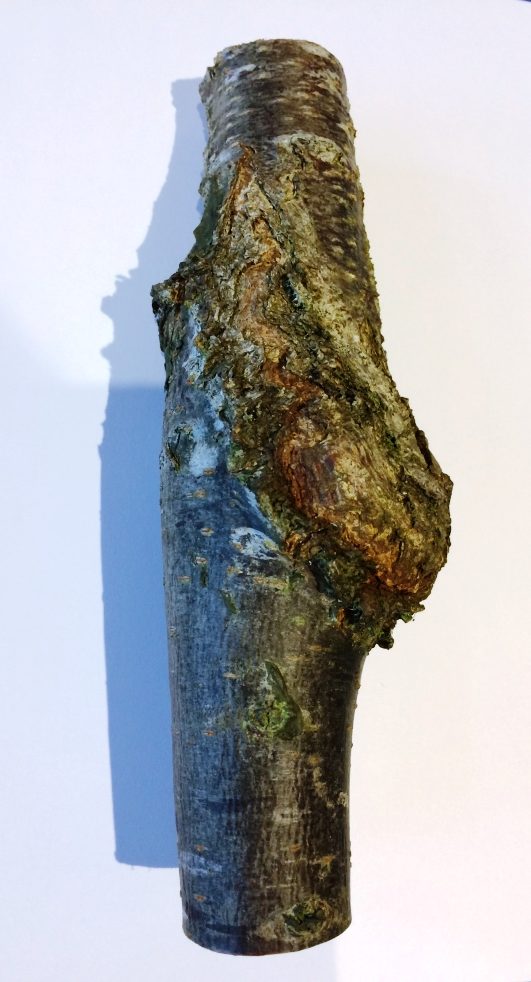
At this grafting place, the original tree (cherry plum) with the smoother bark can be seen well at the bottom. In between, the grafting of the sharp interface. Above, the rougher bark of the grafted apricot tree.
Exhibit: Grafting piece by Ulrich Sachs.
Family „Prunus“
,the large plum family (Prunus is Latin for plum tree).
This family includes grafted stone fruits such as peaches (Prunus persica), sour cherries (Prunus cerasus), apricots (Prunus armeniaca) and plums (Prunus domestica) with the subspecies damsons (Prunus domestica subsp. Domestica). But of course also species occurring wild in nature such as the bird cherry (Prunus avium), blackthorn (Prunus spinosa) or the „wild plums“. They are, after all, the source of the cultivars.
„WILD PLUMS„. Formerly found in large numbers on field margins, stream banks, around the house and yard, they have become rare, the representatives of the „wild plums“. Although wild is also relative here: all subspecies can be crossed with each other, this was and is done with pleasure, the variety is rich and the distinction is difficult even for pomologists (apple experts).
We are familiar with the KRIECHERL, also called Krieche, Griacherl, Griech (Prunus domestica subsp. insititia). The fruits are spherical, yellow to red, the pulp is very difficult to separate from the stone (core). Blooms very early in the year.
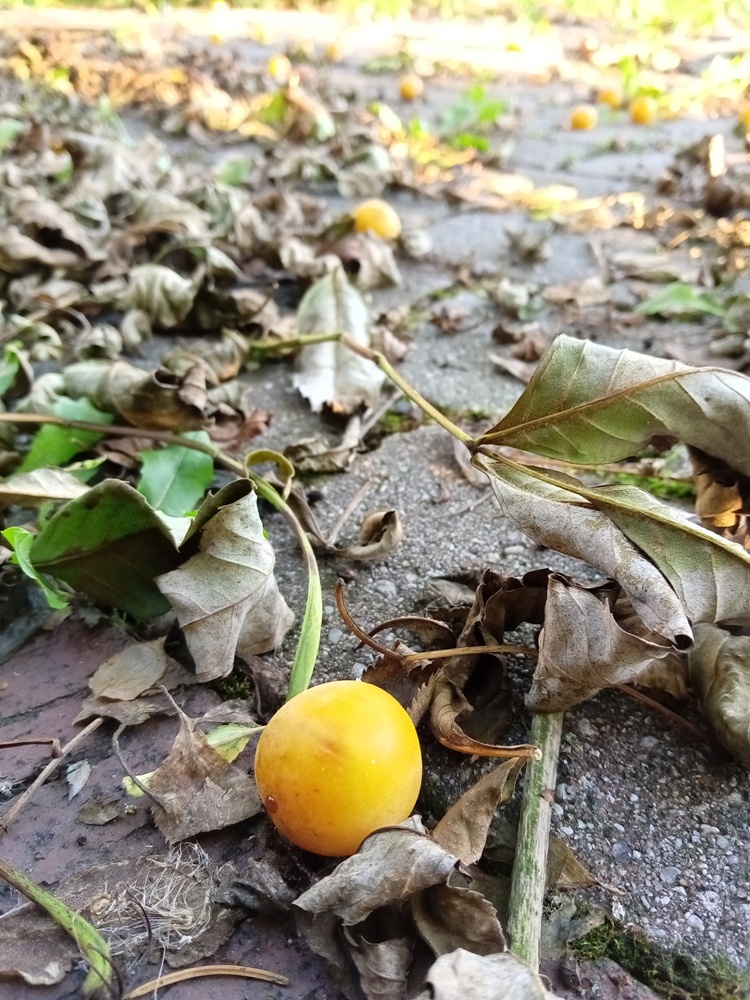
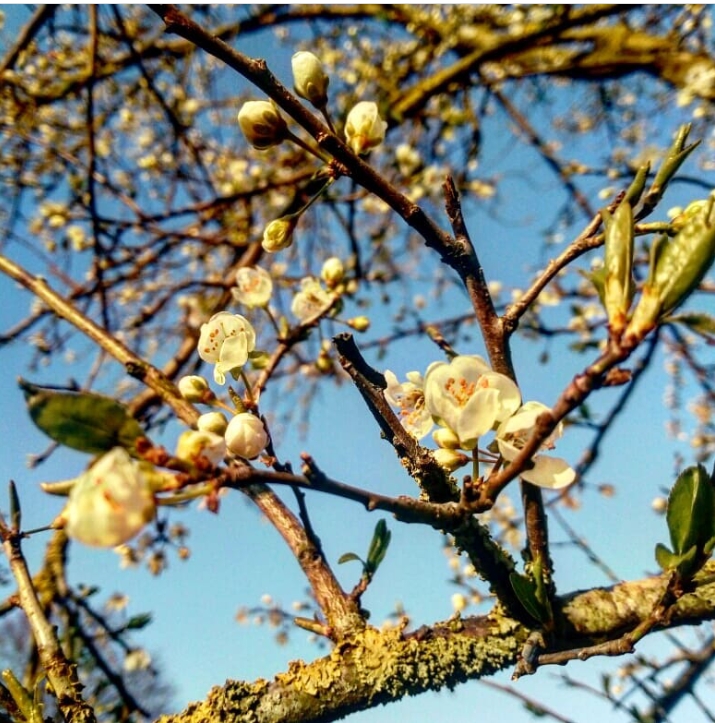


Left: Fruit and flower of a Kriecherl tree, right: House damsons.
CHERRY PLUM or MYROBALANE (Prunus cerasifera) is the first of all stone fruits to bloom, similar to Kriecherl. The fruits, also roundish, can be yellow, orange, red, but also blue and black. The pit ( core) is reddish.
CIBERL or Zibarten are slightly larger, range in color from yellow-green to purple, and are strongly fragrant.
MIRABELLS (Prunus domestiasubsp. syriaca) look very similar to Kriecherln, but bloom much later.
RINGLOTS (Prunus domestica subsp. italica) are yellow-green to blue-violet. The crowns of the saplings are narrow, branches upward, axils and pedicels very hairy.
Sources : Ulrich Sachs (oral), Klaus Strasser: „Von Kriacherln, Ziberl und Mirabellen. Die Pflaumenfamilie zeigt Farbe und Vielfalt“ in Siedlerzeitung (Magazin des österreichischen Siedlerverbandes, Herbst 2020). Otto Wasserman: „Heimischer Obstbau“, Tyrolia 1987. (pictures: Cornelia Schlosser)