

Wood is heavy
Wood from different trees has different weights.
Primarily, the weight is determined by the genetics of a tree. Slow-growing woods are generally heavier than fast-growing ones. Small variations in weight can be caused by environmental influences during growth (location, weather).
Specific gravity describes how much a cube measuring 10x10x10 cm = 1 dm³ weighs.
The lightest wood is the wood of the balsa tree (Orchroma pyramidiale). It is of different density and its weight ranges from 0, 05 to 0,13 kg/dm³. For comparison: Cork weighs 0.24 kg/dm³.
It is difficult to define which is the heaviest wood. On the one hand, the density of the wood varies by plus/minus 10% between samples, and on the other hand, different sources refer to different types of wood as the heaviest wood.
Balsa tree
The balsa tree (Ochroma pyramidale) is found in many areas of the tropics. Its commonly used wood is extremely light.
The balsa tree grows as a medium-sized or rarely large deciduous or evergreen tree. It is very fast growing and can reach growth heights of usually up to 30, rarely up to 50 meters and a trunk diameter of about 100, rarely up to 180 centimeters. The mostly straight, cylindrical and often relatively short trunk has short board roots on older examples.
Balsa wood is used in lightweight construction for model aircraft but also in the wings of wind turbines, but is now partly replaced by plastic or carbon fiber. Further applications are being researched, e.g. as protective plates in composite materials to absorb impact energy.
Ironwood
Under the name „ironwood“ many tree species are known, especially in the tropics, whose wood is valued for its special hardness and has a density of over 1.0 kg/dm³. These woods cannot float and are therefore considered special. Most of them are protected today and their trade is controlled.
Some ironwoods with density above 1.0 kg/dm³:
African ironwood 1.45 kg/dm³ snakewood 1.20-1.35 kg/dm³ Makasser ebony 1.03 kg/dm³
Pockwood 1.20-1.40 kg/dm³ African Grenadilla 1.10 kg/dm³ Rosewood 0.80-1.15 kg/dm³
South African ironwood – probably the heaviest wood
Olea laurifolia (Black Ironwood) is found in South Africa in the KwaZulu-Natal Province. The semi-deciduous tree grows 7-15 meters tall, sometimes as a shrub. The wood is hard, heavy, not very porous and gray to black, the sapwood yellow.
Our wood sample has a specific weight of 1.43 kg/dm³.
The wood is difficult to saw because of the siliceous components, but it is easy to wood turn. It has a fairly fine grain and when polished, a glass-like surface. It is popular with woodturners and knife makers.
The wood is now protected. It was formerly used for supports in mining, railroad ties, tools, and as firewood.
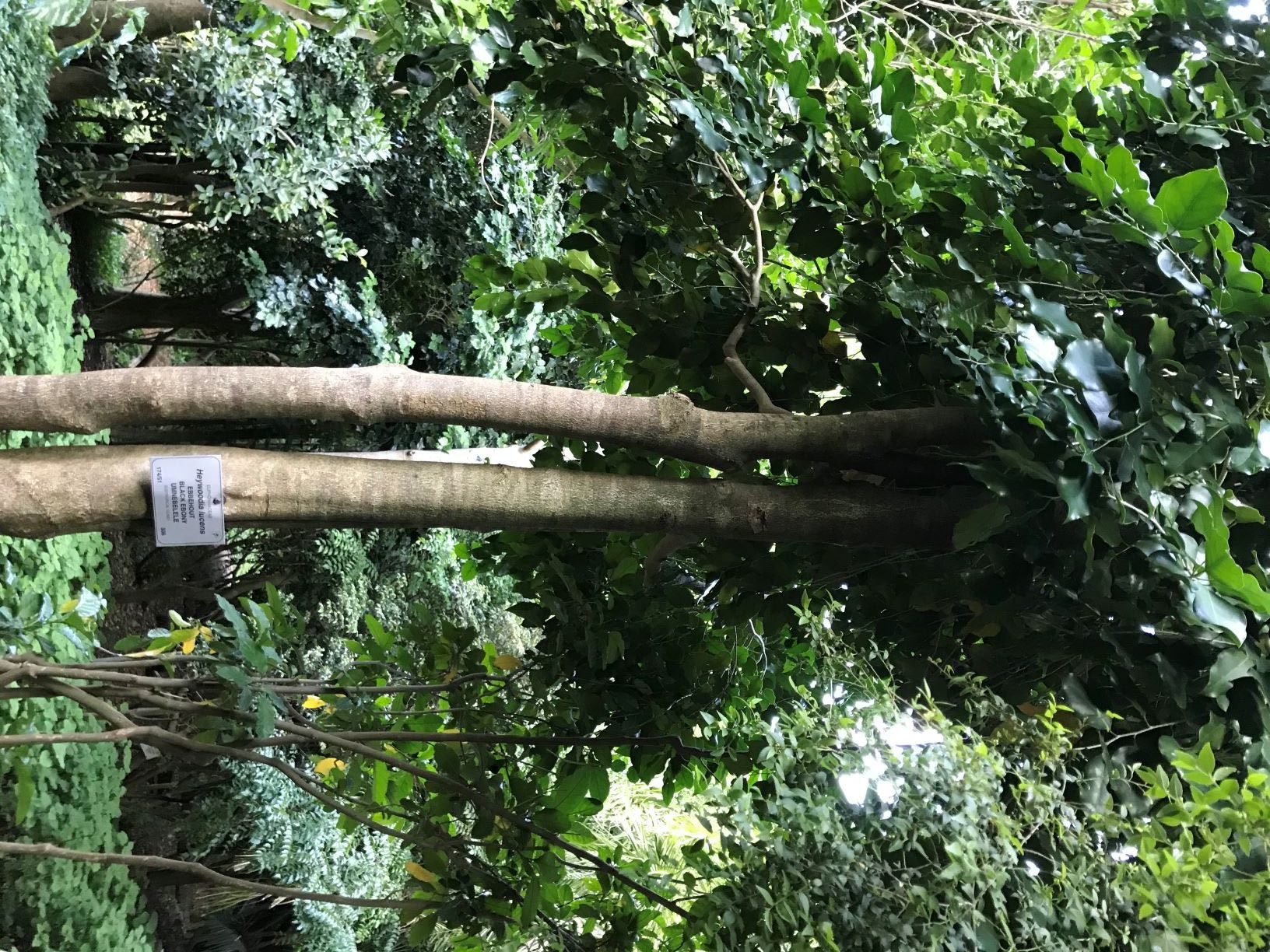
Also among the South African ironwoods is this Heywoodia lucens – Black Ebony from the Kirstenbosch Botanical Gardens. (Photo: Hans Schuster)
Pock wood – the hardest wood in the world
Pock wood comes from the tropical areas of South and especially Central America and is the wood of the guaiac tree. Due to its high density and wood characteristics, pockwood dries very slowly and has a strong tendency to crack. However, the shrinkage behavior is low. The wood is very brittle and therefore difficult to work with. It is about 50% harder than hornbeam, the hardest native wood species. (The hardest coniferous tree is the yew; deciduous trees are considered harder than conifers on average).
The tree combines two things not usually found together: it is a deciduous tree and it is extremely resinous, with 25-27% resin content. This resinous wood has self-lubricating properties. This is utilized in the manufacture of rollers, gears, bevel balls and some tools. There are also special applications such as footboards for gangways, and in the Linz shipyard, ships were placed on blocks of pockwood. During launching, these blocks did not get stuck on the rails due to their self-lubricating property. In former times pockwood was used as keel for sailing ships because of its hardness and stability.
Snakewood – the music wood
Snakewood is a little-known type of wood that is used almost exclusively in musical instrument making, wind instruments and bowing. In general, snakewood refers to the wood of brosimum trees growing in South America. The occurrence is between Paraguay and Venezuela, as well as Guyana and partly in Surinam and Trinidad.
Typically, the snakeskin pattern of dark spots can be seen on the reddish-brown heartwood. The wood surface has a slight sheen. The wood is very difficult to work with because of the very irregular grain. However, it can be polished excellently. Bending the wood is almost impossible even with steam.
The wood is very durable and weather resistant. It is also well resistant to fungal and insect attack.
Specific weights of native woods:
- Boxwood up to 0.83-1.10 kg/dm³.
- Hornbeam up to 0.95 kg/dm³
- oak up to 0,85 kg/dm³
- yew up to 0,90 kg/dm³
- Plum up to 0,85 kg/dm³
- apple tree up to 0,80 kg/dm³
- Beech up to 0,80 kg/dm³
- Ash up to 0,80 kg/dm³
- Walnut up to 0,75 kg/dm³
- Pine up to 0,70 kg/dm³
- maple up to 0,70 kg/dm³
- alder approx. 0,55 kg/dm³
- larch approx. 0,40-0,80 kg/dm³
- birch approx. 0,70 kg/dm³
- lime approx. 0,49 kg/dm³
- spruce approx. 0,50 kg/dm³
- pear approx. 0.53 kg/dm³
Sources: Wikipedia, www.holz-bearbeitung.de, Das Guinness-Buch der Rekorde 1997, Guinness-Verlag Hamburg 1997.